The Russian government is demanding that children adopted by American families in future will have to be taught Russian, according to the Moscow press today. This is one of the demands included in a draft agreement to be discussed by the US and Russian governments on Friday (30 April). The Russian children's rights commissioner, Pavel Astakhov, has said: "If the child already speaks Russian, his social, cultural and linguistic environment should be preserved."
The agreement is said to include a requirement that US adoptive families be monitored by the Russian authorities who would have the right to take the families to court.
Signing this agreement is the price demanded by Russia for resuming adoptions to the US, following the scandal over a Tennessee woman returning her adopted son, Artyom Savelyev, to Moscow on the grounds that she could not look after him.
These conditions look on the face of it impossible for the US government to sign up to. Perhaps there is an some grandstanding going on before the talks start.
Some other bits and pieces: It's been getting harder to adopt from Russia for a few years, and new figures confirm a sharp decline. In 2009, 3813 Russian children were adopted abroad, compared with about 14,000 a year in the 1990s, according Alina Levitskaya, an official of the Russian education ministry. (source: news.ru)
Here's a good article from The Washington Post which looks at the terrible effect on child development of being brought up in a Russian orphanage. See "The origins of the Artyom Savelyev story" below.
And a piece from the NYT on the Montana boot camp for troubled Rusisan adoptees which I think exaggerates the effect of fetal alcohol syndrome and underplays the effect of institutionalisation.
Tuesday, 27 April 2010


Wednesday, 21 April 2010
The Russians don't want a ban on foreign adoption
To judge by some of the comments you see from Russian officials and politicians, you might think that the country wants to ban foreign adoption. Far from it. A new opinion poll carried out for the Russian news agency Interfax shows that only 17 per cent want a ban on foreign adoptions. No less than 68 per cent support foreign adoption as a way to give abandoned children a better life.
That's not the end of the story, however. Forty per cent of those questioned are in favour of "increased supervision of adopted Russian children." How this will work out in practice will be discussed by the US and Russian governments in Moscow on 29-30 April, a meeting delayed by the European flight ban imposed in the wake of the eruption of the Icelandic volcano.
That's not the end of the story, however. Forty per cent of those questioned are in favour of "increased supervision of adopted Russian children." How this will work out in practice will be discussed by the US and Russian governments in Moscow on 29-30 April, a meeting delayed by the European flight ban imposed in the wake of the eruption of the Icelandic volcano.
Tuesday, 20 April 2010
The origins of the Artyom Savelyev story
There has been lots in the media about the problems of adoptive parents raising Russian children who have been damaged by living in state orphanages. Adoptive parents tend to believe that love will conquer all. But this is not the case for all children, particularly those who have been deprived of love and attention in soulless institutions and most probably been subjected to violence and abuse. Here is a feature from the New York Times where parents talk of their problems and a post from the same paper's Motherlode blog.
But what is never explained is how children reach a situation where they cannot bond with an adoptive parent. The most important thing is to understand the atmosphere in a baby house, an orphanage for infants 0-4 years old.
This is how an experienced visitor to Russian state institutions (actually, my wife Sarah) describes them:
"When you go in, the first thing you notice is the silence. You may enter a room full of small babies. But none of them is crying. Crying is not responded to, so they learn there is no point. Groups of children are kept behind locked doors. The staff work 24-hour shifts, so they want to keep the children quiet and passive. The children spend long hours in bed in the afternoon, and in many institutions are given sedatives to encourage them to sleep.
"To the untrained visitor, the todders exhibit signs of autistic behaviour. For example, they do not make eye contact. This must surely be because they get no individual attention. The staff are discouraged from bonding with them: this is to spare the carers heartache when the chilren are moved on to another institution at the age of five. The rooms can be bright, clean and well decorated (not like Romania in the 1980s) with toys on display, but these are often
only for show."
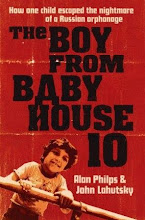
Some children can overcome these terrible conditions of neglect. I'm no child psychologist but it is clear that the first 18 months of a baby's life are crucial. During that period the child learns to interact with adults and to bond with one particular person. If the baby is deprived of that experience at that time, it results in mental, emotional and even physical retardation. Of course there are rare cases where a child can bond with a carer in defiance of the regime of the baby house. This is what happened to John Lahutsky, the hero of my book The Boy from Baby House 10, whose story is one of exceptional triumph over adversity in terrible conditions of abuse and neglect. John had the advantage of living with his birth parents for the first year and a half of his life, during which he learned how to connect with people. It was a life lesson that saved his life. Not all products of the Russian orphanage system have his advantages or his character.
But what is never explained is how children reach a situation where they cannot bond with an adoptive parent. The most important thing is to understand the atmosphere in a baby house, an orphanage for infants 0-4 years old.
This is how an experienced visitor to Russian state institutions (actually, my wife Sarah) describes them:
"When you go in, the first thing you notice is the silence. You may enter a room full of small babies. But none of them is crying. Crying is not responded to, so they learn there is no point. Groups of children are kept behind locked doors. The staff work 24-hour shifts, so they want to keep the children quiet and passive. The children spend long hours in bed in the afternoon, and in many institutions are given sedatives to encourage them to sleep.
"To the untrained visitor, the todders exhibit signs of autistic behaviour. For example, they do not make eye contact. This must surely be because they get no individual attention. The staff are discouraged from bonding with them: this is to spare the carers heartache when the chilren are moved on to another institution at the age of five. The rooms can be bright, clean and well decorated (not like Romania in the 1980s) with toys on display, but these are often
only for show."
Some children can overcome these terrible conditions of neglect. I'm no child psychologist but it is clear that the first 18 months of a baby's life are crucial. During that period the child learns to interact with adults and to bond with one particular person. If the baby is deprived of that experience at that time, it results in mental, emotional and even physical retardation. Of course there are rare cases where a child can bond with a carer in defiance of the regime of the baby house. This is what happened to John Lahutsky, the hero of my book The Boy from Baby House 10, whose story is one of exceptional triumph over adversity in terrible conditions of abuse and neglect. John had the advantage of living with his birth parents for the first year and a half of his life, during which he learned how to connect with people. It was a life lesson that saved his life. Not all products of the Russian orphanage system have his advantages or his character.
Monday, 22 March 2010
Your questions answered
So many people have got in touch with me with questions after reading The Boy from Baby House 10 that I thought it was time to give the answers a wider publicity. I hope this blog will answer common concerns. If you want to get in touch with me directly, you can email me on alan@alanphilps.com and I will respond as quickly as I am able.
A father of five from Poland, Mr Wieslaw Zych, asks what he can do to help children in Vanya's position and what is being done in Britain, my home country.
The first place to look is the website of Action for Russia's Children (ARC), which was co-founded by my wife Sarah. Here is the link: www.actionarc.com. You can see what ARC does and how it operates.
ARC is an all-volunteer organisation so all donations go straight to independent Russian projects. No one takes a salary, and there is no office, so really the overheads are minimal. Among the projects it helps to fund are Centre for Curative Pedagogics in Moscow. Vanya/John visited the CCP, as is is recorded in the book. You can make a donation to ARC in pounds, euros or dollars. Many thanks - your donations are sorely needed.
A father of five from Poland, Mr Wieslaw Zych, asks what he can do to help children in Vanya's position and what is being done in Britain, my home country.
The first place to look is the website of Action for Russia's Children (ARC), which was co-founded by my wife Sarah. Here is the link: www.actionarc.com. You can see what ARC does and how it operates.
ARC is an all-volunteer organisation so all donations go straight to independent Russian projects. No one takes a salary, and there is no office, so really the overheads are minimal. Among the projects it helps to fund are Centre for Curative Pedagogics in Moscow. Vanya/John visited the CCP, as is is recorded in the book. You can make a donation to ARC in pounds, euros or dollars. Many thanks - your donations are sorely needed.
Subscribe to:
Comments (Atom)